Swaminathan Iyer’s first eighteen months at CHESS KLUB BTM Layout 4th Stage — and the one habit that explains it
Most children who take up chess spend the first year losing, and Swaminathan Iyer was no exception.
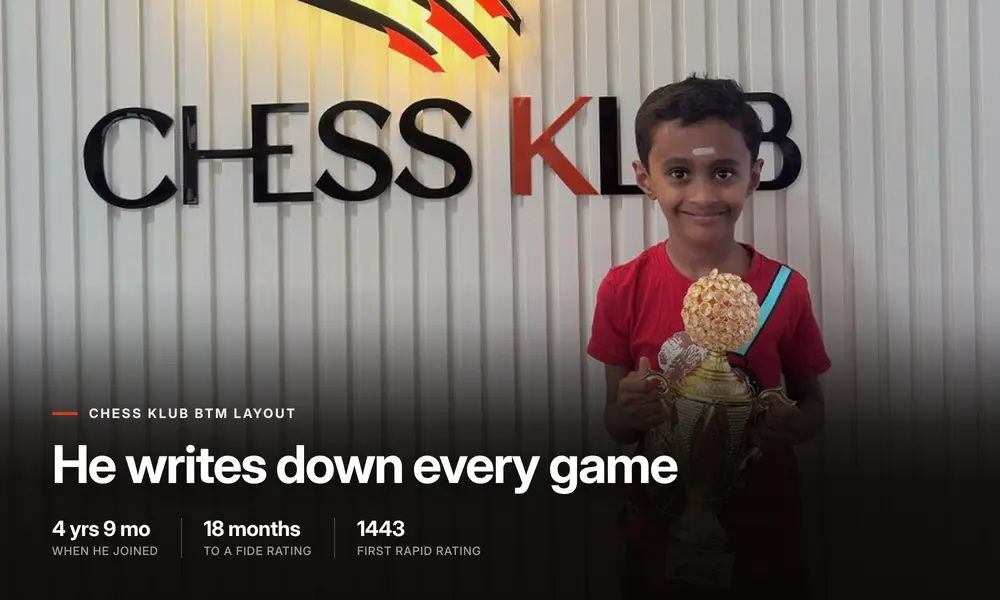
He joined the beginner group at CHESS KLUB BTM Layout 4th Stage in April 2025, twice a week, four years and nine months old — a few weeks short of his fifth birthday. For months he did what nearly every small child does. He learned how a knight moves, and forgot. He learned what checkmate looks like, and walked into one. And he watched only his own pieces, unaware of the rook on an open file waiting to end the game behind him.
Back-rank mate catches children for a reason that has nothing to do with chess. Seeing it means interrupting your own train of thought to ask what somebody else is doing — a developmental step, not a tactical one, and no drilling makes a four-year-old take it early.
Eighteen months later he had a published FIDE rapid rating. What happened in between is mostly not about talent.
February 2026: twenty-second place
Ten months after his first class he played his first tournament, the Friends Trust Under-8 rapid. He was five and a half, unrated, and some opponents were two years older.
He scored 3 out of 6 and finished twenty-second. No debut trophy — a small boy, a long day, three wins, three losses, bottom half of the field.
Buried in the result was a performance rating of 1400: the strength he had actually played at across six games. Nobody awards that. It is arithmetic, calculated from whom he beat and who beat him, and at five and a half it said something twenty-second place did not.
March: beaten twice before lunch
A month later came his first FIDE-rated event, the Christ School International Rapid. He lost round one to a player rated 1446, round two to a player rated 1417, and finished with 2 points from 9 games.
Two wins, seven losses. Nine rounds is a long day for a five-year-old and most of it was spent losing.
He went back the following week.
The habit
Here is the part that explains the rest.
After every practice game, Swaminathan writes down the notation — the full move-by-move record — then takes it home and goes back through it. He was five when he started. Notation is not difficult, but it is tedious, and almost no child that age does it voluntarily.
Writing your own moves down forces you to slow down, name what you did, and see the position as a record rather than a feeling. Reviewing afterwards is how a player discovers the rook on the open file had been sitting there six moves before it mattered. The habit does the exact thing four-year-olds cannot — it makes you look at the whole board, including the parts that are not yours. It just does it at the kitchen table, until one day it starts happening during the game instead.
Vinutha, who runs CHESS KLUB BTM Layout 4th Stage, puts it this way:
“Swaminathan joined CHESS KLUB when he was just 4.8 years old. There are certain qualities that set a winner apart from others, and Swamy truly embodies them. A few things that stand out about him are his consistency, attentiveness and passion for the game.
He has always been regular to his classes, and his attentiveness during sessions reflects his genuine love for chess. One habit that deserves special appreciation is that he records the notations of every practice game he plays and makes it a point to review those games once he gets back home. This commitment to learning beyond the classroom is what makes him special.
Another important part of his journey is the incredible support of his parents. Their commitment to bringing him regularly to classes and ensuring his participation in tournaments has played a significant role in his progress.
Swamy’s journey is a beautiful example of how a child’s passion, discipline, consistent practice and strong parental support come together to shape a winner.”
If you take one thing from this article, take that habit. It costs nothing and needs no coach present.
April: the first trophy, and then the fall
At the Bruhat Bengaluru District Chess Association Under-7 he scored 3.5 out of 4 and won it. His first title.
Two weeks later, moved up into an older age group, he made illegal moves and lost on the spot. An illegal move in a rated game is not something you argue about: it is called, it is recorded, and the game can end there. For a six-year-old, it is bleak.
He has not done it since.
May: fifteenth in the state, first of his own year
His first Karnataka State Under-7 Championship produced 6 points from 9 games and fifteenth place — and, among every player born in 2020 in that field, the best performance of any of them. That second part matters more, because in an Under-7 field a child born in 2020 concedes as much as two years to the top of the draw.
The clock
He had asked for a chess clock. He got one for his sixth birthday. The next day he took third place at the Universal Chess Academy Under-7, beating a boy who had beaten him before.
October: a published rating
In October 2026 his first official FIDE rapid rating was published: 1443, over his first eight rated games. Eighteen months after sitting down at a CHESS KLUB board not knowing how the pieces moved, he was a rated player. You can look him up: FIDE ID 577015290.
What the rating did not fix
A classical tournament in Chennai — the Forking Knights International FIDE Rated Below 1650 Open 2026 — taught him something rapid chess never had. Classical games run four or five hours, and for a six-year-old the opponent eventually stops being the problem. He drew round one against a player rated 1506, then found out what hour four feels like.
There were other hard days: big opens where he was among the smallest in the hall, games lost on the clock in winning positions, kings left exposed because the attack was more interesting than the defence.
And the rating went down. In the November list it stood at 1418, twenty-five points below where it started. That is the honest shape of a chess career and almost nobody publishes it. A rating is not a trophy you keep but a running measurement, and when a six-year-old starts entering stronger fields it moves against him for a while. Every rated player alive has had that month.
Rounds six and seven
Then, at a Black Knight Chess Center event: he lost round four. He lost round five. He won round six. He won round seven.
Earlier that year, two losses in a row would have ended the tournament — not technically, emotionally. He won the next two. At those events he also finished second twice, and beat the boy who had beaten him twice the month before.
If you are trying to work out whether chess is doing anything for your child, do not look at the trophies. Look at what happens after the second loss. That is the part that transfers — to a bad test result, to a fight with a friend, to the first real failure that has nothing to do with a chessboard. Chess just happens to measure it.
CHESS KLUB promoted him to Intermediate 1, where he is now. His coach at BTM Layout 4th Stage is Chirag, who takes classes across all age groups.
Eighteen months, in order
| Milestone | When, and what happened |
|---|---|
| Joined CHESS KLUB BTM Layout 4th Stage | April 2025, aged four years nine months |
| First tournament | February 2026 — ten months later |
| First result | 3 / 6, twenty-second place |
| First FIDE-rated event | March 2026 — 2 / 9 |
| First title | April 2026 — Bruhat Bengaluru District Chess Association Under-7, 3.5 / 4 |
| First state championship | May 2026 — 6 / 9, best among 2020-born players |
| First published FIDE rapid rating | October 2026 — 1443 |
| Level now | Intermediate 1 |
Ten months of classes before a first tournament. Two more before a first win. Seven after that before a rating. Nobody posts that timeline, because it does not fit in a reel. It is the real one.
For the parent reading this
The slow part is not a problem. Ten months before a first tournament is the foundation, not a warning sign. Children rushed into competition before they can see the whole board learn to dread tournaments rather than enjoy them.
The losses did the teaching. The 2-from-9, the illegal moves, the games lost on the clock, the rating falling in November. Every visible improvement here arrives directly after something went badly wrong.
The habit is copyable. Most of what separates Swaminathan from an equally talented child who plateaued is that he writes his games down and looks at them again. Your child can start this week.
So is the parenting. Vinutha named it unprompted: his parents bring him every week and enter him for tournaments. That is not a talent. It is a calendar.
He is six. He has a rating. Mostly, he still wants to play.
Start where he started
Swaminathan began in a beginner group, twice a week, at CHESS KLUB BTM Layout 4th Stage — four years and nine months old, and still forgetting how a knight moves.
Eighteen months later he was a rated player in Intermediate 1, taught by Chirag, who coaches every age group at the centre.
For class timings, location and enquiries, visit CHESS KLUB BTM Layout 4th Stage.