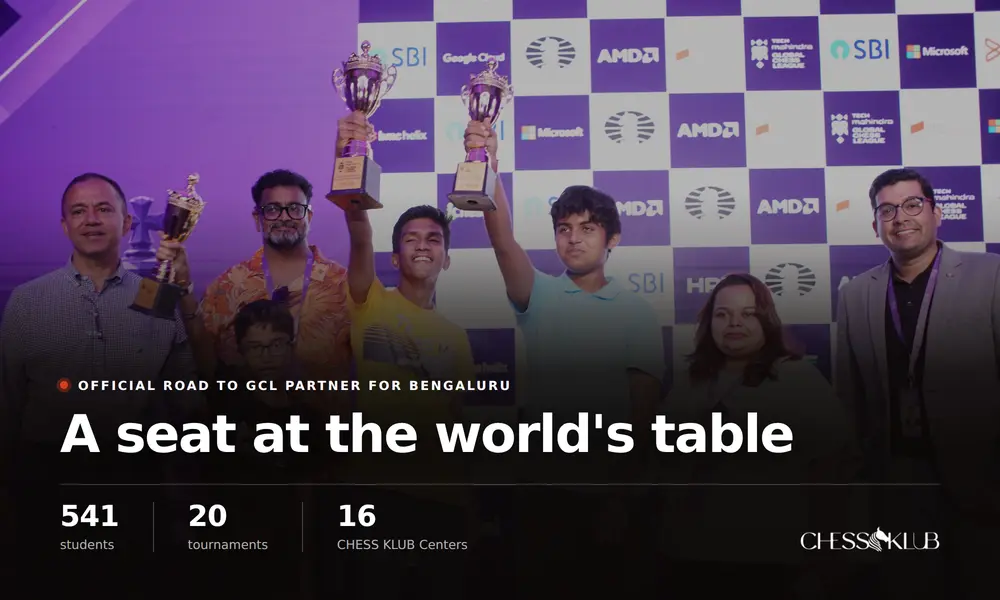
When the Global Chess League came to Bengaluru in September 2026, Magnus Carlsen, Viswanathan Anand, Ian Nepomniachtchi, Koneru Humpy and Vidit Gujrathi all played within a few kilometres of our centres. For most of the city’s young players, that would have been something to watch on a screen.
For 541 of them, it was something to be part of.
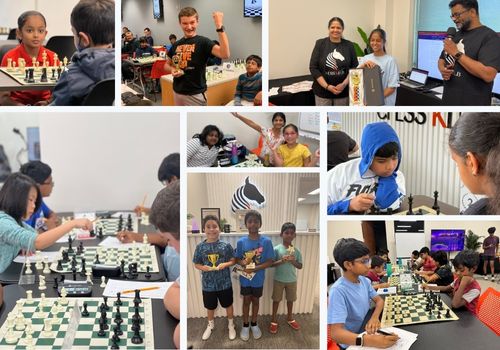
CHESS KLUB was chosen as the Global Chess League’s partner for Road to GCL in Bengaluru — the official student pathway into the league’s biggest season yet. Between 8 and 30 August we ran 16 free tournaments across 16 of our centres. On 7 September we brought the qualifiers to a finale at the league venue. And across the following week, while the world’s best played a few rooms away, we ran three more tournaments inside the GCL Fanzone for the people who had come to watch.
Twenty tournaments. 655 players. Here is how it happened.
What is the Global Chess League?
The Global Chess League is the world’s first and largest official franchise chess league — a joint venture between Tech Mahindra and FIDE, the International Chess Federation. It was built to do for chess what franchise leagues did for cricket and football: turn a solitary, slow game into a team sport with squads, rivalries and a season.
The structure is genuinely unusual, and the details are what make it work.
- Six franchises, six players each. Every squad is built to a fixed template: one Icon, two Superstar Men, two Superstar Women, and one Prodigy. Men and women play on boards of identical value. There is no separate women’s section and no reduced weighting — a win by a woman on board four counts exactly as much as a win by the Icon on board one. In a sport still arguing about how to structure women’s competition, GCL simply removed the question.
- A scoring system that punishes safety. A win with the black pieces is worth 4 game points; a win with white is worth 3; a draw is worth 1 each. Because Black is historically at a disadvantage, the extra point rewards winning from the harder side — and it makes the quiet, risk-free draw a losing strategy. Match points are 3 for a win, 1 for a tie, 0 for a loss, with game points as the tiebreaker.
- Rapid, not classical. Twenty minutes per player for the whole game, with a two-second increment from move 41. Fast enough to watch, slow enough to be real chess.
- Format. A double round robin — ten matches per team, thirty in all — then a final between the top two.
- Prize pool: one million US dollars. Half distributed by final standings, $450,000 in proportion to the game points each team accumulates across the league, and $50,000 to the champions. Every game is worth money, right to the last round.
Season 4: What Happened in Bengaluru
Season 4 was played at The Lalit Ashok — the first time the league has been staged in Bengaluru. Previous editions ran in Dubai (2023), London (2024) and Mumbai (2025).
| Franchise | Icon | Squad |
|---|---|---|
| Alpine APL Pipers | Magnus Carlsen | Anish Giri, Vidit Gujrathi, Divya Deshmukh, Koneru Humpy, Volodar Murzin |
| Ganges Grandmasters | Ian Nepomniachtchi | Levon Aronian, Leinier Domínguez, Polina Shuvalova, Stavroula Tsolakidou, Leon Luke Mendonca |
| PBG Alaskan Knights | Viswanathan Anand | Arjun Erigaisi, Yağız Kaan Erdoğmuş, Kateryna Lagno, Nino Batsiashvili, Abhimanyu Mishra |
| Triveni Continental Kings | Alireza Firouzja | Wei Yi, Aravindh Chithambaram, Zhu Jiner, Alexandra Kosteniuk, Pranav V |
| FYERS American Gambits | Javokhir Sindarov | Nihal Sarin, Daniil Dubov, Bibisara Assaubayeva, Sarasadat Khademalsharieh, Marc’Andria Maurizzi |
| CheQ Mumba Masters | Maxime Vachier-Lagrave | Pranesh M, Shakhriyar Mamedyarov, Harika Dronavalli, Carissa Yip, Bardiya Daneshvar |
The final went to two legs. Ganges Grandmasters and defending champions Alpine APL Pipers finished the league stage locked on 18 match points, separated only by game points. The first leg ended 3–3. In the second, Nepomniachtchi beat Carlsen on the Icon board with a bishop sacrifice — 29…Bxf2+ — that turned a lost position into a won one, and Stavroula Tsolakidou beat Koneru Humpy to clinch it. Ganges Grandmasters took their first title.
Tsolakidou was named Player of the Tournament with six wins and three draws. Polina Shuvalova posted the highest individual score of the league, 7 points from 10 games.
And the audience showed up. FIDE reported the venue packed across nine days of play, the league’s YouTube channel growing by more than 80,000 subscribers to 104,000, and its Instagram following rising from 60,000 to 145,000 across the season.
Why This Matters for Chess in India
India is now the centre of gravity in world chess, and Season 4 made that visible in a way a world championship match cannot.
Look again at those squads. Vidit Gujrathi. Divya Deshmukh. Koneru Humpy. Aravindh Chithambaram. Pranav V. Nihal Sarin. Leon Luke Mendonca. Viswanathan Anand. Arjun Erigaisi. Pranesh M. Harika Dronavalli. Eleven Indian players, spread across every one of the six franchises, sitting opposite Carlsen and Nepomniachtchi and Firouzja as teammates and opponents rather than as visitors.
That is the argument for a league, made concretely. A child watching a world championship sees one person reach a summit. A child watching GCL sees eleven Indians in the room, on equal boards, being picked for teams — and among them Divya Deshmukh, Harika Dronavalli and Koneru Humpy playing boards that count exactly as much as Magnus Carlsen’s.
Three things follow, and they are why a league changes a chess culture rather than merely entertaining it.
- It makes chess watchable. Rapid time controls, team rivalries, a scoring system that forces decisive play, and a nine-day arc a commentator can build a story around. Parents who have never played a game can follow a GCL match. That is how a sport recruits.
- It makes chess a career rather than a gamble. A million-dollar pool distributed by performance across a whole season — not winner-take-all — means professional chess can support more than a handful of people. For a parent weighing whether their child’s talent is worth investing in, a functioning professional structure is more persuasive than any individual prodigy’s story.
- It puts the world’s best within reach. Which is what we were asked to arrange.
How CHESS KLUB Came to Run Road to GCL
The Tech Mahindra team approached us.
The reason was straightforward, and it is the reason we built the network the way we did: CHESS KLUB has a larger presence in Bengaluru than any other chess academy in the city. Twenty centres, spread across neighbourhoods rather than concentrated in one part of town. If you want to reach school students across Bengaluru — not the ones who already travel to tournaments, but the ones who have never entered one — you need rooms in their neighbourhoods and coaches who already know them.
That is what we were asked for, and it is what we had.
Grand spectacles draw the crowds, but grassroots conviction builds the movement. The Global Chess League didn’t just light up the main stage – it proved that when you connect elite arenas to local centers like CHESS KLUB, you don’t just gain spectators. You build an ecosystem.
True collaboration isn’t built top -down; it’s fueled from the ground up, where young talent takes its very first move on the road to greatness.
Sudev Rajah, CEO & Co-Founder, CHESS KLUB
Road to GCL: 541 Students, 16 Neighbourhoods
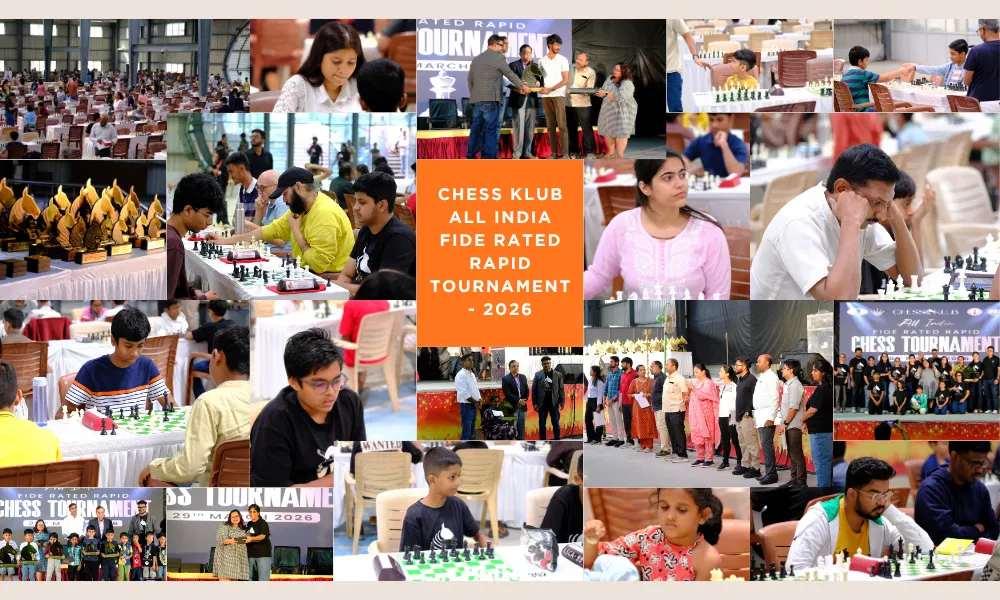
Road to GCL was open to school and pre-university college students under 18, and entry was free at every one of the 16 tournaments. Between 8 and 30 August 2026 we ran them at 16 CHESS KLUB centres.
| Date | Centre | Players |
|---|---|---|
| 8 Aug | Nobel Residency Road | 22 |
| 8 Aug | Subramanyapura | 32 |
| 9 Aug | Electronic City (Bughouse) | 36 |
| 15 Aug | Varthur | 27 |
| 15 Aug | JP Nagar | 38 |
| 16 Aug | Nagarbhavi | 19 |
| 16 Aug | Dasarahalli | 30 |
| 22 Aug | Yelahanka | 17 |
| 22 Aug | Hosa Road | 48 |
| 22 Aug | Kasavanahalli | 32 |
| 23 Aug | Medahalli | 15 |
| 23 Aug | Ananth Nagar | 58 |
| 23 Aug | Hesaraghatta | 39 |
| 29 Aug | HSR Layout | 43 |
| 30 Aug | RR Nagar | 45 |
| 30 Aug | New BEL Road | 40 |
| Total | 541 | |
An average of 34 players per tournament, from a low of 15 at Medahalli to a high of 58 at Ananth Nagar. Running them took more than 20 CHESS KLUB coaches across the city, alongside support staff and our franchise owners.
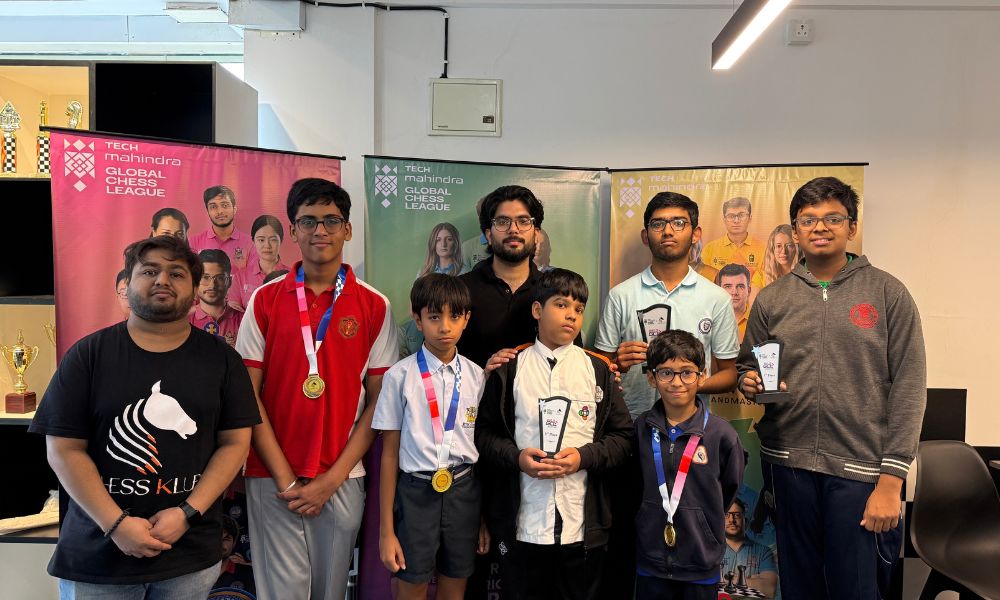
Winners of the Road to GCL Tournament held at CHESS KLUB – Nobel Residency Road, Bengaluru
That spread is the whole point. A single citywide tournament at one venue would have drawn a fraction of this — the students whose parents could give up a Saturday to drive across Bengaluru. Sixteen neighbourhood tournaments drew 541, and the ones that drew best were not the addresses you would predict. Ananth Nagar, Hosa Road and RR Nagar all out-registered HSR Layout. Chess demand in this city is not concentrated where a marketing plan would assume it is, and you only find that out by opening doors in sixteen different neighbourhoods on the same weekend.
The Electronic City leg on 9 August was played in Bughouse — two-on-two, captured pieces passed to your partner to drop back on their board. Fast, loud, collaborative and slightly chaotic. It drew 36 players, one of the strongest turnouts of the opening fortnight, and it is the format most likely to convince a child who thinks chess is quiet that chess is not quiet.
The Road to GCL Finale: 7 September, Inside the Venue
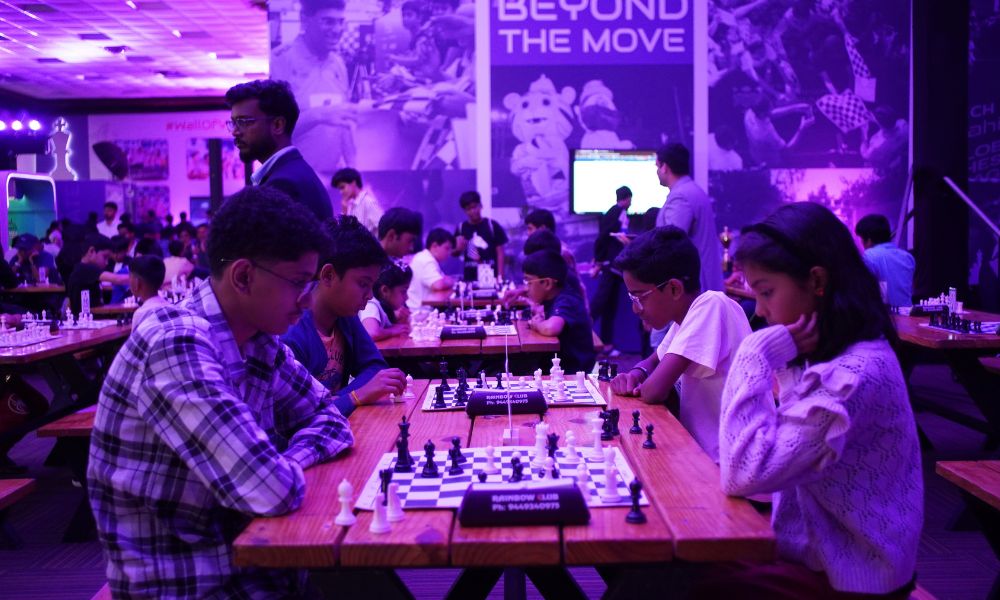
Finale of the Road to GCL Shining Stars Tournaments held in Bengaluru
On 7 September, while the Global Chess League was under way, 49 qualifiers from the 16 neighbourhood tournaments came together for the Tech Mahindra School and University Finale Rapid Tournament 2026 — five rounds, played at the league venue.
And they did not only play there. The finalists were able to enter the main hall and watch the Global Chess League games live — the same boards where Carlsen, Anand, Humpy and Nepomniachtchi were playing.
That is what winning a leg in August actually bought. Not a certificate. A rated game at The Lalit Ashok, and a seat in the hall.
It finished the way you would want it to. Yeshas H and Adhrit Das Purkayastha both won all five of their games. Neither dropped so much as a draw across the day, and the title was settled only on tiebreak, with Yeshas taking it on Buchholz. Sragvidha S finished third on 4 points.
| # | Player | Score |
|---|---|---|
| 1 | Yeshas H | 5 / 5 |
| 2 | Adhrit Das Purkayastha | 5 / 5 |
| 3 | Sragvidha S | 4 / 5 |
The Fanzone: Chess for Everyone Who Came to Watch
The venue had a Fanzone — a space for spectators who came to watch the world’s best. Most leagues give those fans a screen and a seat. GCL asked CHESS KLUB to give them a board.
| Date | Tournament | Players |
|---|---|---|
| 8 Sept | Tech Mahindra GCL Fan Zone Blitz Tournament for Women | 24 |
| 9 Sept | Tech Mahindra GCL Fan Zone Blitz Tournament for Seniors | 18 |
| 13 Sept | Tech Mahindra GCL Fan Zone Blitz Tournament for Creators, PR and Journalists | 23 |
| Total | 65 | |
Three tournaments, five rounds each, three completely different rooms. That was deliberate.
- Women’s Blitz — 8 September. Karelia Vidhi won it outright with a perfect 5 from 5, the only clean sweep of the day. Chainani Dimple and Simantini Huchche finished on 4, separated on tiebreak.
- Senior’s Blitz — 9 September. Prasanna B M also went 5 from 5. Shyam Vijay took second and Hariharan Subramony third, both on 4 points. The field’s ratings ran to 1952 — these were not beginners passing the time between rounds.
- Creators, PR and Journalists Blitz — 13 September. The most competitive of the three: four players finished level on 4 points, and the title went to Rohit Kumar Sharma on tiebreak — ahead of FM Aarav Sarbalia, rated 1947 and the strongest player in the field, with Kshitish Gore third.
| Tournament | 1st | 2nd | 3rd |
|---|---|---|---|
| Women’s Blitz | Karelia Vidhi (5/5) | Chainani Dimple (4) | Simantini Huchche (4) |
| Senior’s Blitz | Prasanna B M (5/5) | Shyam Vijay (4) | Hariharan Subramony (4) |
| Creators, PR & Journalists | Rohit Kumar Sharma (4) | FM Aarav Sarbalia (4) | Kshitish Gore (4) |
The Women’s and Senior’s Blitz addressed the two gaps everyone in Indian chess acknowledges and few people programme for. Chess in India has an age-16 problem and a gender problem: enormous participation among young children, a steep drop-off for girls, and almost nothing organised for adults who want to start or return. A Fanzone is the right place to attack both, because the people there have already chosen to spend a day watching chess. They are not a cold audience. They are the most receptive room in the country, and nobody usually hands them a board.
The Creators Blitz was the one that surprised us. Chess did not become the most-watched game on the internet because of tournaments. It became that way because creators — streamers, YouTubers, commentators, the journalists who cover it — made it watchable to people who could not play it. Every child who walks into a CHESS KLUB centre asking to learn the London System because they saw it on YouTube is downstream of somebody’s channel.
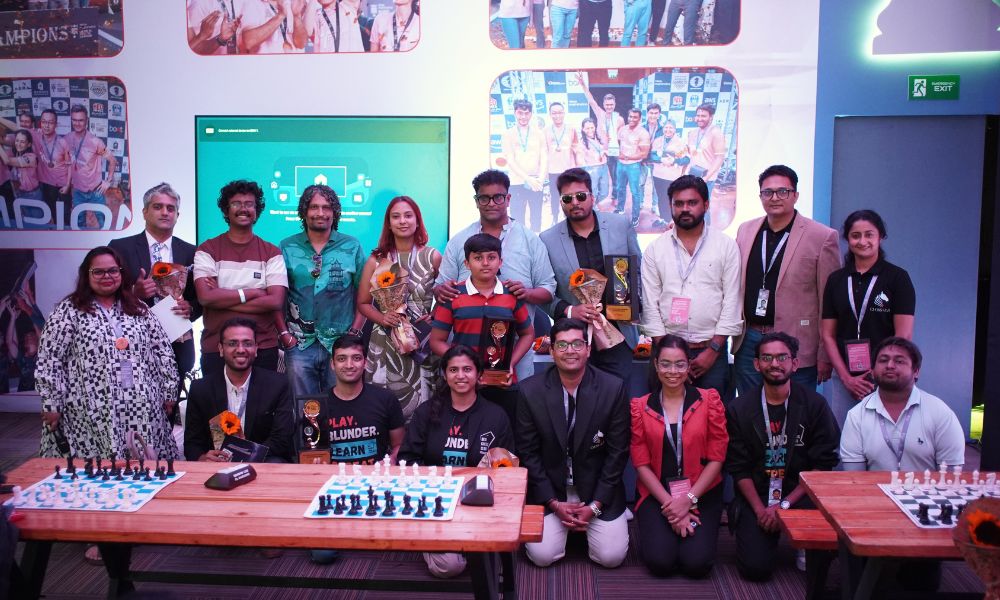
Winners of the ‘Creators, PR and Journalists Blitz’ held in Bengaluru as part of the GCL Fanzone tournaments, with CHESS KLUB team
Putting them on the boards, in blitz, in front of an audience on the final day of the league was not a novelty slot. It was an acknowledgement that the people who grow the game are not only the people who win it. And it produced the closest finish of the week — a four-way tie at the top, with a FIDE Master beaten on tiebreak.
Twenty tournaments, 655 players
Three things we took from it.
| Series | Tournaments | Players |
|---|---|---|
| Road to GCL — neighbourhood legs | 16 | 541 |
| Finale of Road to GCL | 1 | 49 |
| Fan Zone blitz events | 3 | 65 |
| Total | 20 | 655 |
- Proximity is the argument. For twenty years the case for chess to Indian parents has been made with abstractions — concentration, patience, academic benefit. All true, all hard to feel. A child who has played a rated game at The Lalit Ashok and then walked into the hall to watch Magnus Carlsen play does not need the abstraction. They have a memory instead.
- Neighbourhood beats venue. 541 students turned up because the tournament was a short drive from home rather than an expedition across the city, and because it cost nothing to enter. That is the structural reason CHESS KLUB is built the way it is, and Road to GCL tested it at scale.
- Chess is not only for children. The Women’s and Senior’s Blitz were a reminder that we, like most academies, point almost all of our attention at the 5–15 bracket. The demand outside it is real, it turned up, and it is largely unserved.