


The Vienna Game is an opening in chess that begins with the moves:
- e4 e5
- Nc3
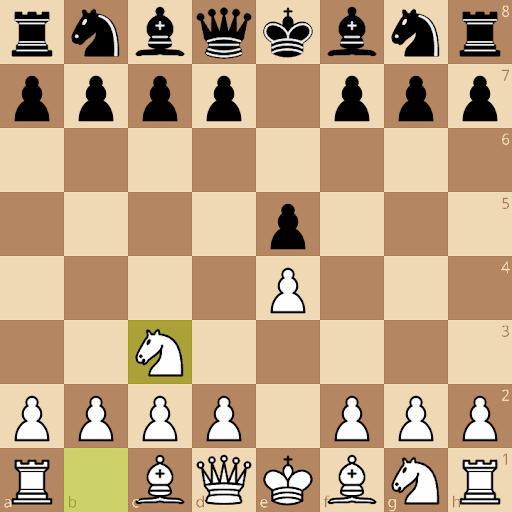
White develops the queen's knight instead of immediately committing to Nf3, White's most common second move. Black usually responds with either 2...Nf6 or 2...Nc6. The original idea behind the Vienna Game was to play a delayed King's Gambit with f4, but in modern play White often adopts a quieter approach, such as by playing 3.Bc4 or 3.g3.
As per modern theory, if played correctly, the opening leads to equality with best play by both sides.
History
The Vienna game, analyzed in the mid 19th century by a group of Viennese chess players in the early years was played in tournaments by Wilhelm Steinitz (1836-1900), Jacques Mieses (1865-1954) and Rudolf Spielmann (1883-1942).
With 2 Nc3, White makes a developing move, and allows flexibility to play his kingside f pawn. Black usually replies 2…Nc6 or 2…Nf6, when White has 3 ways to continue:
- Play f2-f4
- Development with Bc4 & d3. His future setup will depend on Black’s plan
- The fianchetto of the King’s bishop (g3, Bg2)
Plan 1 results after 1.e4e5 2Nc3 Nc6, 3 f4exf4, 4 Nf3, in a position from the King’s Gambit accepted, with the extra moves Nc3/ Nc6. The other knight move, 2…Nf6, prepares …d5, and leads after 3 f4d5 4 fxe5Nxe4 leads to the Main line of the Vienna game. As per theory, it is not difficult in this line for Black to get equality.
Plan 2 is possible after both knight moves. But care is required. After 2…Nf6 3Bc4, White must also be prepared for 3…Nxe4, when 3 Qh5 is the start of the Frankenstein -Dracula variation.
Plan 3, the fianchetto variation, is the modern treatment, chosen by the late World Champion Boris Spassky. After 2…Nf6 3g3 the active 3…d5 can be played, but then after 4 exd5 Nxd5, 5 Bg2 White can count on his strong bishop on g2.
The Vienna game suits club players very well, because there is not a lot of theory. This may catch your opponent unawares, as he might be expecting the Ruy Lopez or the Italian game. It is a very flexible opening, because it can be used aggressively like the King’s Gambit or it can be played in a slow & positional way.
In-Depth Look
Black's most common response is 2...Nf6, which usually continues with 3.f4, 3.Bc4, 3.g3, or 3.Nf3. 2...Nc6 is also quite common. Some lines are reached like the Berlin-Vienna Hybrid Variation, commonly reached by
a) 2Nc3 Nf6 3.Bc4 Nc6 4.d3, 2.Nc3 Nc6 3.Bc4 Nf6 4.d3,
b) 2.Bc4 (the Bishop's Opening) Nf6 3.d3 Nc6 4.Nc3.
- 2...Nf6 (Main Line)
- 3.f4 (Falkbeer Variation)
- 3...d5 4.fxe5 Nxe4
- 5.Nf3 (main line - see below image)

- 5.Qf3 (Paulsen Attack)
- 5.d3 (Oxford Variation)
- 5.Nf3 (main line - see below image)
- 3...d5 4.exd5
- 3...d5 4.d3 (Steinitz Variation)
- 3...d5 4.fxe5 Nxe4
- 3.Bc4 (Stanley Variation, also often assigned to Bishop's Opening)
- 3...Nxe4 4.Qh5 (Frankenstein-Dracula Variation)
- 3...Nxe4 4.Nf3 (Boden-Kieseritzky Gambit)
- 3...Nc6 4.d3 (Berlin-Vienna Hybrid Variation)
- 3...Bc5 (Spielmann Attack)
- 3...Bb4 (Reversed Spanish Variation)
- 3.g3 (Mieses Variation)
- 3...d5 4.exd5 Nxd5 5.Bg2 Nxc3 6.bxc3 (main line)
- 3.Nf3 Nc6 (Four Knights Game)
- 3.Nf3 Bb4 (Petrov's Defense, Three Knights Game, by transposition)
- 3.d4 exd4 4.Qxd4 Nc6 (Center Game, by transposition)
- 3.a3 (Mengarini Variation)
- 3.f4 (Falkbeer Variation)
- 2...Nc6 (Max Lange Defense)
- 3.f4 exf4 (Vienna Gambit)
- 4.Nf3 g5 5.h4 g4 6.Ng5 (Hamppe–Allgaier Gambit)
- 4.Nf3 g5 5.Bc4 g4 6.0-0 (Hamppe–Muzio Gambit)
- 4.Nf3 g5 5.d4 (Pierce Gambit)
- 4.d4 (Steinitz Gambit)
- 3.Bc4 Nf6 4.d3 (Berlin-Vienna Hybrid Variation)
- 3.Bc4 Bc5 (Symmetrical Variation)
- 3.g3 (Paulsen Variation)
- 3.Nf3 (Three Knights Game)
- 3.d4 (Fyfe Gambit)
- 3.f4 exf4 (Vienna Gambit)
- 2...Bc5 (Anderssen Defense)
- 3.Nf3 d6 4.d4 exd4 5.Nxd4 (main line)
- 3.Nf3 d6 4.Na4 (exchange line)
- 3.Bc4 (Bishop's Opening, Classical Variation, by transposition)
- 3.f4 d6 4.Nf3 (King's Gambit Declined, Classical Variation, by transposition)
- 2...d6
- 3.Bc4 Nf6 4.d3
- 3.f4 (Omaha Gambit)
- 3.Nf3 (Philidor Defense, by transposition)
- 2...Bb4 (Zhuravlev Countergambit)
One importantly played line is the Vienna Gambit.
Vienna Gambit: 2...Nc6 3.f4 exf4
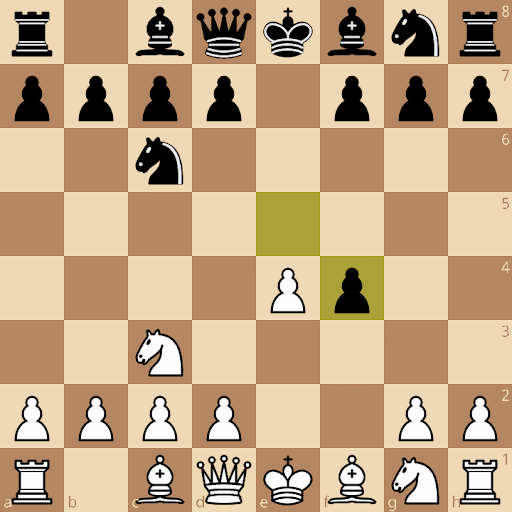
White sacrifices a pawn to gain control of the center, with a similar idea to the King's Gambit. This can lead to these following lines:
Steinitz Gambit: 4.d4
The Steinitz Gambit, 1.e4 e5 2.Nc3 Nc6 3.f4 exf4 4.d4, was a favourite of Wilhelm Steinitz, the first World Champion. White allows Black to misplace White's king with 4...Qh4+ 5.Ke2, hoping to prove that White's pawn center and the exposed position of Black's queen are more significant factors. The Steinitz Gambit is rarely seen
Hamppe–Muzio Gambit 4.Nf3 g5 5.Bc4 g4 6.0-0
This extremely sharp gambit is usually followed by gxf3 7.Qxf3. As with its close relative in the King's Gambit, the Muzio Gambit, White sacrifices the knight on f3 in return for a powerful attack against the black king. It is named after Austrian theoretician Carl Hamppe. The Dubois Variation continues 7...Ne5 8.Qxf4 Qf6.
Hamppe–Allgaier Gambit: 4.Nf3 g5 5.h4 g4 6.Ng5
This is another extremely sharp line that resembles the Allgaier Gambit of the King's Gambit. Unlike in that line, after 5...g4, White cannot play 6.Ne5, which would be the equivalent of the Kieseritzky Gambit, due to Black's knight on c6. Black's knight is not particularly useful in defending against White's attack after 6.Ng5, just to note.
Pierce Gambit: 4.Nf3 g5 5.d4
The Pierce Gambit, 3...exf4 4.Nf3 g5 5.d4, usually continues 5...g4 6.Bc4, and is also often reached by transposition with 5.Bc4 g4 6.d4. It is also frequently reached from the Quaade Gambit of the King's Gambit. After this, the most common continuation is 6...gxf3, followed by 7.0-0 or 7.Qxf3, with White sacrificing a knight for activity. Black's main fifth move alternative is 5...d6, a line also frequently reached from the Fischer Defense of the King's Gambit. 5...Bg7 is also played but has duller prospects.
The lines of Vienna Defense should be used not as a main or sole weapon against 1…e5, that would be too easy for the opponent to prepare for the game. Yet it is worth having such a rare systemin reserve and employing it from time to time as a surprise.
FAQ
Who invented the Vienna Game?
A group of Viennese chess players in the early years was played in tournaments by Wilhelm Steinitz (1836-1900), Jacques Mieses (1865-1954) and Rudolf Spielmann (1883-1942).
Why is the Vienna opening so rarely played by GMs?
Perhaps because it does not offer as many lines and sidelines like Italian game or Ruy Lopez.
How does the Vienna Game rank as an opening?
It definitely can be played at the highest level and has been used by many GMs, as a surprise weapon.
What are the benefits of playing the Vienna Game as an opening in chess?
You play lesser known lines which may have less dense theory and can be easier to prepare.
Bibliography
- The Modern Vienna Game by Ovetchkin and Soloviov
- The Vienna Gambit for the Club Player by Payne & Read
- The Complete Vienna by Tseitlin .
- de Firmian, Nick (2008). Modern Chess Openings: MCO-15.