A Complete Learner’s Guide. The Ruy Lopez Opening is one of the most popular openings played by White and is also considered one of the best ways for White to gain an advantage in the Opening. World Champions across the world have been playing the Ruy Lopez Opening exhaustively since the early 20th century.
What is Ruy Lopez?
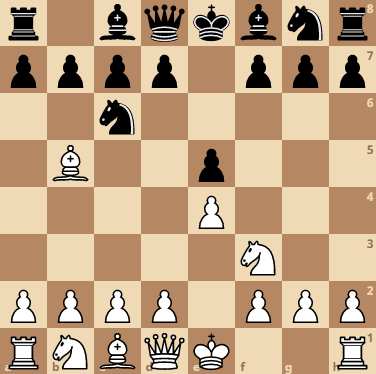
The Ruy Lopez is a very popular Spanish Opening named after the Spanish Priest of the 16th century – Ruy Lopez de Segura. This opening did not get immediately popular as openings like the King’s Gambit were popular around this time. It was towards the end of the 19th century when the Ruy Lopez Opening became famous. The opening begins as follows:
- e4 e5
- Nf3 Nc6
- Bb5
History and Origin
The 16th-century Spanish priest devised a study on the Ruy Lopez Opening in a book called Libro del Ajedrez that was written in 1561. The opening was popularised when Carl Jaenisch, the Russian theoretician, rediscovered this opening in the mid-19th century. A common nickname for this opening is “The Spanish Torture”, as Black finds it difficult to achieve equality.
Theory
The concept behind Bb5 on the third move is to attack the Knight on c6 that is defending the e5 pawn. White is attacking the e5 pawn with the White Knight on f3. However, White’s idea to win the c6 Knight is tricky as if White plays Nxe5 followed by the Bishop and Knight exchange, Black can respond with a Queen fork, attacking the White pawn on e4 and Knight on e5, by playing Qd4:
- e4 e5
- Nf3 Nc6
- Bb5 a6
- Bxc6 dxc6
- Nxe5 Qd4
Irrespective of this exchange, Bb5 is a good move as it promotes the development of the White pieces and allows White to castle on the next move. Bb5 also sets a potential pin on the Black Knight and King. The main reason behind Bb5 is to disrupt Black’s pawn structure.
The Ruy Lopez Opening is best developed in Open Games, where there are multiples variations of the opening. Let’s take a look at all the possible variations:
Mainline
Morphy Defense – Most Popular Move
Black’s most common third move is 3..a6 which puts White in a position where White has to decide whether to take the Knight on c6 or not. Black plans to follow a6 with b4 to break the pin if White retreats with Ba4. The move a6 became popular and got its name when the World Champion Paul Morphy started playing this as the third move.
Morphy Defense – Closed Variation
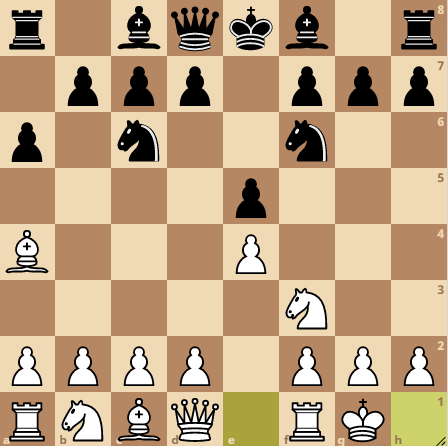
The most common variation of the Morphy Defense is the Closed Variation :
- e4 e5
- Nf3 Nc6
- Bb5 a6
- Ba4 Nf6
- 0-0 Be7
Exchange Variation
By playing Bxc6 instead of Ba4, White disrupts Black’s pawn structure and gives White an opportunity to play d4. This would pave a path for major exchanges allowing the game to progress to the end game. After Qxd4, White is in control of the centre, and White has an advantage.
Trap
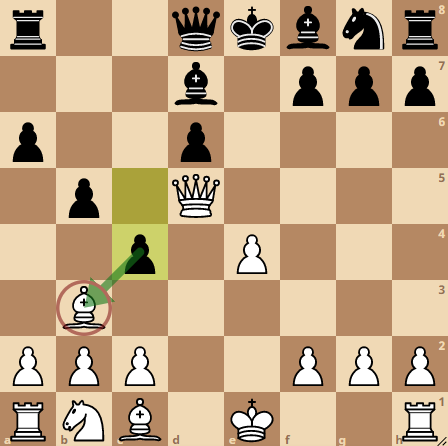
In this position, the Noah’s Ark Trap is a trap that White should look out for:
- e4 e5
- Nf3 Nc6
- Bb5 a6
- Ba4 d6
- d4 b5
- Bb3 Nxd4
- Nxd4 exd4
- Qxd4 c5
- Qd5 Be6
- Qc6+ Bd7
- Qd5 c4
Variations
Norwegian Defence (Taimanov or Wing Variation)
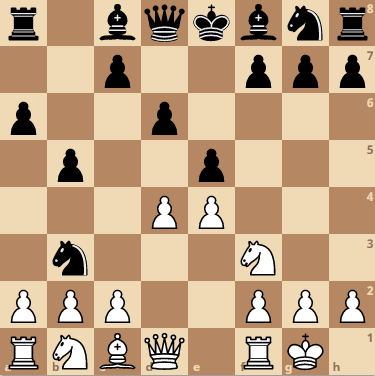
The variation aims to capture the White Bishop; however, this variation is often considered too time-consuming:
- e4 e5
- Nf3 Nc6
- Bb5 a6
- Ba4 b5
- Bb3 Na5
- 0-0 d6
- d4 Nxb3
A sacrifice that could take place on the 6th move would be Bxf7 which would be followed by Nxe5, which would force the Black King to move out. However, after this sacrifice, White may find it difficult to maintain this position; hence the sacrifice may be ambitious for some players. Thus, the common combination is as explained above.
Mackenzie Variation
In this variation, White plays d4 on the 5th move, and this variation was named after George Henry Mackenzie. This variation does not provide any advantage in theory according to modern strategies. This line then continues with exd4 and transposes into the Open Defence.
Steintz Defence Deferred
This variation is also called the Russian Defence, where White castles and then Black then plays d6. This defence was played by players like Rubinstein and Alekhine.
The Open Defence
- e4 e5
- Nf3 Nc6
- Bb5 a6
- Ba4 b5
- 0-0 Nxe4
- d4 b5
- Bb3 d5
- dxe5 Be6
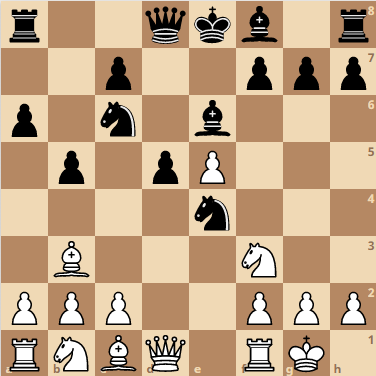
This variation allows Black to use the time that White takes to regain a pawn by trying to gain control in the centre.
Marshall Attack
- e4 e5
- Nf3 Nc6
- Bb5 a6
- Ba4 Nf6
- 0-0 Be7
- Re1 b5
- Bb3 0-0
- c3 d5
- exd5 Nxd5
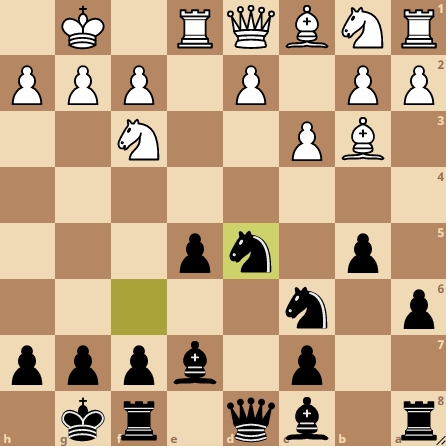
An aggressive variation for Black to adopt in response to the Ruy Lopez Opening is the Marshall Attack.
- e4 e5
- Nf3 Nc6
- Bb5 a6
- Ba4 Nf6
- 0-0 Be7
- Re1 b5
- Bb3 0-0
- c3 d5
- exd5 Nxd5
In this variation, Black sacrifices a pawn, and the sacrifice allows Black to remove White’s Kingside defenders. This also gives Black a lead in development, and Black can pose a strong attack on White’s Kingside.
Berlin Defence
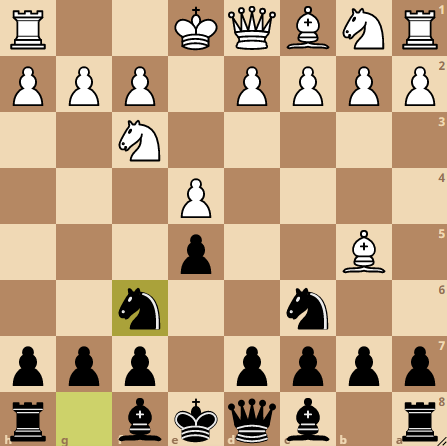
In this variation, Black responds to Bb5 with Nf6 instead of a6 and has been played by World Champions like Kasparov, Carlsen and Anand. White usually responds with castling, and Black can play Nxe4. White may have an advantage because of a slightly better pawn structure as compared to Black’s pawn structure.
Weakness
As a result of a break in Black’s pawn structures, Black may try to gain space on the Queenside with moves like a6 and b5. This may represent a Queenside attack or a Queenside counterplay which may be a cause of a weakness while playing the Ruy Lopez Opening.
Statistics
| RESULTS | PERCENTAGE |
|---|---|
| White Wins | 33.1% |
| Black Wins | 34.0% |
| Draws | 32.9% |
Step by Step Learning
Books
- The Chigorin Bible – A Classic Defence to the Ruy Lopez: A Classic Defence to the Ruy Lopez by Ivan Sokolov
- Fighting the Ruy Lopez (Starting Out Series) by Milos Pavlovic
- Ruy Lopez Tactics: Chess Opening Combinations and Checkmates by Tim Sawyer
- Play the Ruy Lopez by Andrew Greet
Famous Games
FAQ
1. Why play the Ruy Lopez Opening?
The Ruy Lopez Opening is a great start for White as it allows White to develop its pieces, and White has the capability to disrupt Black’s pawn structure. This allows White to gain a positional advantage. It is also considered a great opening for beginners as it gives White an attacking start.
2. Is Ruy Lopez an aggressive opening?
The Ruy Lopez Opening has the potential to become an aggressive opening depending on Black’s responses. Morphy Defense is one of the aggressive variations of the Ruy Lopez Opening.
3. What is the point of the Ruy Lopez opening?
The point of the Ruy Lopez Opening is for White to break Black’s pawn structure in the opening.
4. Is the Ruy Lopez open or closed?
The Ruy Lopez has an Open and Closed variation.
5. Is Ruy Lopez for beginners?
As White or Black, if you are familiar with the opening, Beginners can play the opening, as long as they are aware of the possible traps and loopholes.
6. Is Ruy Lopez good for Black?
Black gains a solid position in the Ruy Lopez Exchange Variation which is a great variation for Black to choose to play. The other variations require Black to have a slight amount of skill to tackle the positions.