A perfect guide to the Nimzo Indian Defense, a great opening for beginners and advanced players and one of the best openings for black.
The Nimzo Indian Defense is a hypermodern opening that begins with the following moves:
- d4 Nf6
- c4 e6
- Nc3 Bb4
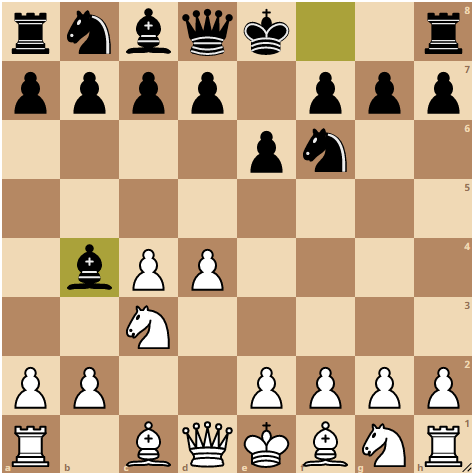
This Opening is considered to be a great Opening for Beginners and Advanced players and is one of the best Openings for Black to play.
History and origin
The Nimzo-Indian Defense was introduced by Aron Nimzowitsch in the early 20th century and has been played by almost every World Champion in the past 100 years. The Opening was first used by Aron, who is the founder of the hypermodern school of chess. Aaron believed that one does not need to control the center by filling it with pawns but instead let the opponent do the hard work.
Theory
This Opening provides scope for many variations while still providing Black with an advantage. The opening offers Black an opportunity to double White’s ‘c’ pawns and is the best defense against White’s d4. This allows Black to develop a delayed pawn structure which provides Black with more flexibility. Black’s third move pins the White Knight stopping White from immediately expanding into the center with ‘e4’.Both sides now have a variety of variations to play, making this Opening extremely complex.
General Concept
- The idea behind Black’s Bb4 is to double White’s pawns on the ‘c’ file.
- The ‘c’ file then becomes a static weakness for White.
- Black tries to reduce the coverage of the White Bishops.
- Black blocks White’s chances of creating a pawn centre.
Classical Line
4. Qc2
This move is a popular line which was the former World Champion Capablanca’s response to the Opening. This variation is also called the Capablanca variation and was popular in the early days of the Nimzo Indian defense. White aims to gain the Black Bishop without compromising on the pawn structure, however, White’s Kingside development is delayed. Here Black has four responses to Qc2:
a. 0-0
- d4 Nf6
- c4 e6
- Nc3 Bb4
- Qc2 0-0
- a3 Bxc3+
- Qxc3 b6
- Bg5
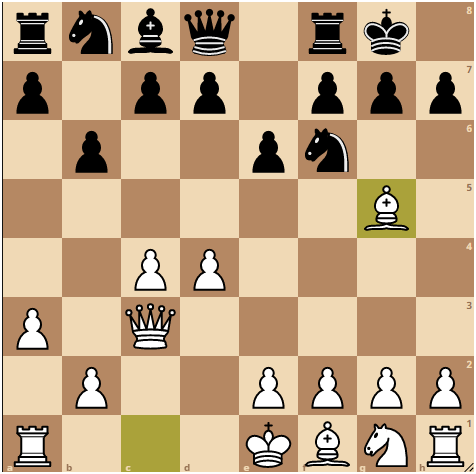
This is the mainline and the most popular line in the Classical Variation. This is the safest option for Black with the intention to develop the Queenside Knight and Bishop eventually.
b. c5
Since the Queen moves to c2, there is no defense left for the pawn on ‘d4’, and c5 takes advantage of this weakness. Black can pose pressure on the pawn on ‘d4’ throughout the game; hence White plays dxc5. Now Black can choose whether to capture the pawn with the Bishop or the Knight.
c. d5
This was Mikhail Botvinnik’s favourite move that directly attack’s the centre. White responds with cxd5, and Black can take the pawn on d5 with either the Queen or the pawn. Taking the d5 pawn with the Queen leads to the Romanishin System, where Black’s idea is to eventually get a grip on e4 and open the e6 square for the Black Bishop.
d. Nc6
This is called the Zurich or Milner-Barry variation where Black loses the dark-squared Bishop but allows the light-squared Bishop to develop by placing the Black pawns on d6 and e5.
Rubenstein Variation
In this variation, White responds with e3 on the fourth move followed by Bd3 or Ne2 on the 5th move. Black can respond to e3 by playing b6, which allows the Black Knight to come on f6 and the Black Bishop to come on b7 to control the ‘e4’ square.
a. Ne2 (5th)
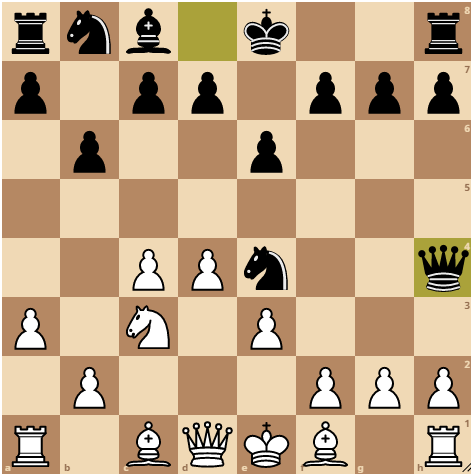
This move prevents the doubling of the White pawns and is the most popular choice for White in the Rubenstein variation. If Black decides to play Bxc3, White can respond with Nxc3 and still have control over the e4 square. The Black Knight on f6 can also move to the e4 square, which can be followed by Qh4.
- d4 Nf6
- c4 e6
- Nc3 Bb4
- e3 b6
- Ne2 Bxc3
- Nxc3 Ne4
- a3 Qh4
b. Bd3 (5th)
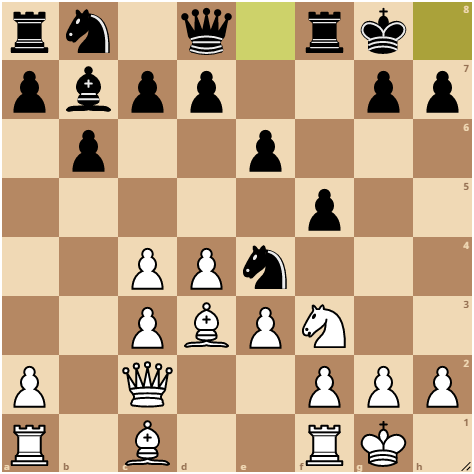
This line continues in a manner similar to the Ne2 line.
- d4 Nf6
- c4 e6
- Nc3 Bb4
- e3 b6
- Bd3 Bb7
- Nf3 Ne4
- Qc2 Bxc3
- bxc3 f5
- 0-0 0-0
Kasparov Variation
The Hungarian Defense is Black’s response to the Italian Game Opening with the move Be7. This is not a very popular opening but is played by a few Grand Masters from time to time. The idea is that Black avoids the complex positions that come up in Guioco Piano and the Two Knights Defense variations. White’s best response to this move is to play d4 to gain control in the center.
Samisch Variation
- d4 Nf6
- c4 e6
- Nc3 Bb4
- a3 Bxc3
- bxc3 b6
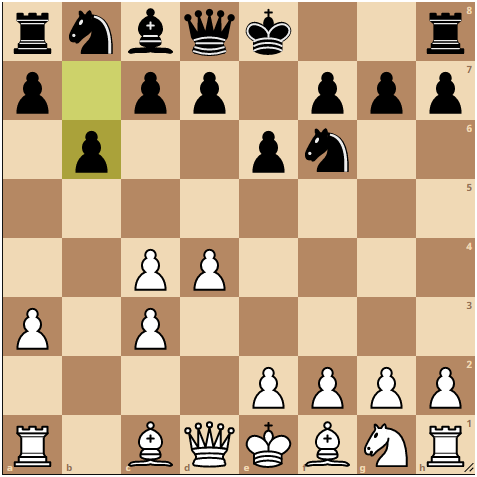
Black plans to pose an attack on the double pawns on the ‘c’ file by playing Ba6. White responds with f3 to strengthen the pawn structure and Black then plays Ba6. White finally plays e4 and then Black plays Nc6. White now has three options
- Bg5
- e5
- Bd3
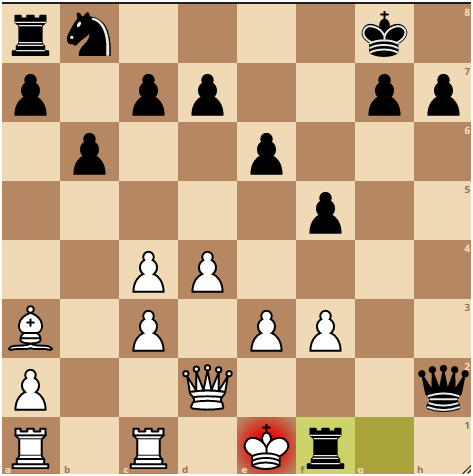
Traps in the Nimzo Indian Defense
- d4 Nf6
- c4 e6
- Nc3 Bb4
- e3 b6
- Bd3 Bb7
- Nf3 Ne4
- Qc2 f5
- O-O Bxc3
- bxc3 O-O
- Nd2 Qh4
- Ba3 Nxd2
- Qxd2 Bxg2
- Kxg2 Qg4+
- Kh1 Qf3+
- Kg1 Rf6
- Rfc1 Qh3
- f3 Rg6+
- Kf2 Qxh2+
- Ke1 Rg1+
- Bf1 Rxf1
Statistics
| RESULT | DATA |
|---|---|
| White Wins | 34.7% |
| Black Wins | 31.9% |
| Draws | 33.4% |
Step by Step Learning Process
Grandmaster Games
Books to Refer to
- The Nimzo-Indian Defense by Michael Roiz
- Opening Repertoire: Nimzo and Bogo Indian: Nimzo & Bogo Indian by Christof Sielecki
- How to Play the Nimzo-Indian Defense: A Key Introduction to a Major Defense by Raymond Keene OBE Shaun Taulbut.
FAQ
1. Is the Nimzo-Indian Defense a good Opening for Beginners to play?
The Opening has a simple theoretical format to follow with a wide range of available variations making it a good option for Beginners.
2. Why play the Nimzo-Indian Defense?
The Nimzo-Indian Defense has a theory that is easy to follow with the game guided towards development and gaining the centre in the Opening, making it a great Opening for Beginners as well as advanced players to play.